
One of Canada’s Most Valuable, and Most Overlooked, Tax Credits

Disability Tax Credit Canada 2026 eligibility guide by Easy Tax Canada, accountants in Mississauga and Brampton
The Disability Tax Credit is one of the most underused tax credits in Canada, and we mean that literally. Millions of Canadians who likely qualify never apply, often because they assume their condition “isn’t severe enough.” Here is how the DTC actually works in 2026, and why it is worth a second look even if you were turned down, or never applied, in the past.
Who Actually Qualifies
The DTC is available to individuals with a severe and prolonged physical or mental impairment that markedly restricts their ability to perform a basic activity of daily living, such as walking, feeding, dressing, or mental functions necessary for everyday life. It also covers individuals who require extensive life-sustaining therapy, including certain conditions like Type 1 diabetes, which is deemed to automatically meet this requirement.
A common misconception is that the DTC is only for visibly severe disabilities. In practice, we regularly help clients qualify based on chronic conditions, mental health conditions, and impairments that are not outwardly obvious but significantly affect daily functioning.
How to Apply: Form T2201
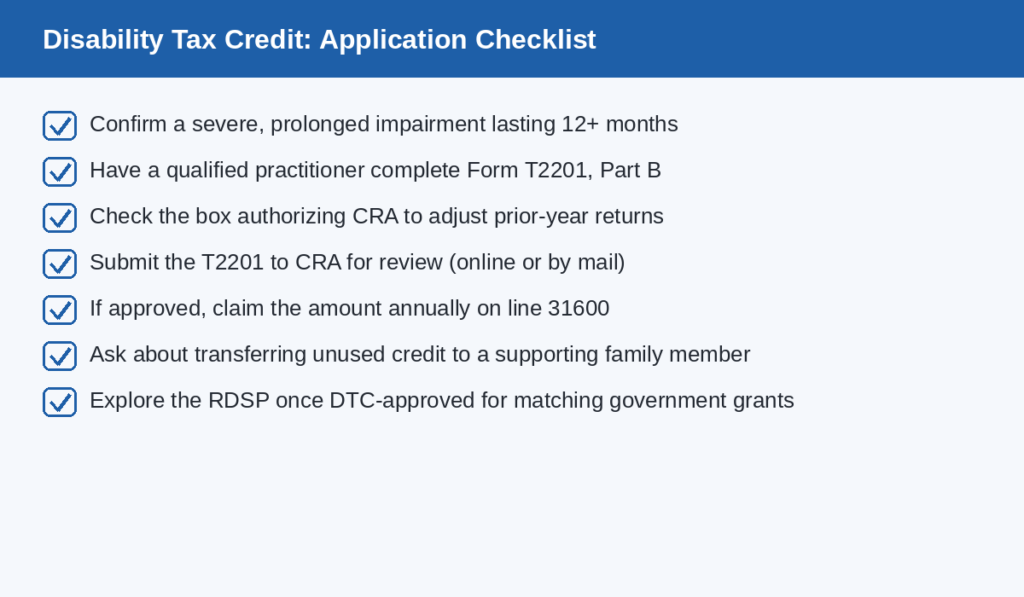
Disability Tax Credit application checklist for Form T2201, Easy Tax Canada
Form T2201, the Disability Tax Credit Certificate, has two parts. You complete Part A with your basic information, and a qualified medical practitioner completes Part B, describing how your impairment restricts daily activities. The quality of this medical description matters enormously, generic diagnosis language is far less effective than a detailed explanation of functional limitations.
| Always check the box on Form T2201 authorizing the CRA to adjust your previous tax returns. This single checkbox is what triggers a retroactive claim, and skipping it is one of the most common reasons families leave money on the table. |
Retroactive Claims: Up to 10 Years
If the CRA determines that your impairment existed in prior years, you can claim the disability amount retroactively for up to 10 years, provided you filed tax returns for those years. Because the DTC is non-refundable, the actual refund depends on how much tax was payable in each of those years, either by the eligible person or by a supporting family member the credit is transferred to.
What the DTC Unlocks Beyond the Tax Credit
- Eligibility to open a Registered Disability Savings Plan (RDSP), which can attract significant government matching grants and bonds.
- An increase to the Canada Child Benefit if the approved person is a child.
- Access to the Canada Disability Benefit for eligible working-age adults, a separate monthly payment program.
- The Child Disability Benefit, a tax-free monthly top-up for families with an approved child.
If Your Application Is Denied
A denial is not necessarily the end of the process. Many successful DTC claims come after an initial rejection, often because the original medical description did not fully capture the functional impact of the condition. Requesting a second review with more detailed medical information, or having a different practitioner complete Part B, can change the outcome.
Final Thoughts
The DTC is not a monthly cheque, it is a credit claimed on your tax return, but its downstream effects, retroactive refunds, RDSP eligibility, and increased benefits for families, can add up to a meaningful amount over time. If you or a family member has a condition that affects daily living, it is worth a proper review rather than assuming you won’t qualify.
| Need Help With This? Talk to Easy Tax Canada. Our team is led by a former CRA Auditor and Collections Officer with over 15 years of experience, backed by CPAs who know the Canadian tax system inside and out. We help individuals, self-employed professionals, and small businesses across Mississauga, Brampton, and the Greater Toronto Area file accurately, plan ahead, and stay CRA-compliant year-round. Visit easytaxcanada.com to book a consultation or explore our blog for more tax guidance. |