
FHSA, the Home Buyers’ Plan, and What Mississauga & Brampton Buyers Should Know
First-time home buyer tax benefits Canada 2026 guide by Easy Tax Canada, accountants in Mississauga and Brampton
Buying a first home in the GTA is expensive enough without leaving tax benefits on the table. The good news is that Canada now offers two powerful tools, the First Home Savings Account (FHSA) and the RRSP Home Buyers’ Plan (HBP), that can be used together to build a down payment faster. Here is how each one works in 2026, and how our Mississauga and Brampton clients are combining them.
The First Home Savings Account (FHSA)
The FHSA combines the best features of an RRSP and a TFSA. Contributions are tax-deductible, just like an RRSP, but qualifying withdrawals for a first home are completely tax-free, just like a TFSA, and unlike the Home Buyers’ Plan, nothing needs to be repaid.
- Annual contribution limit: $8,000.
- Lifetime contribution limit: $40,000.
- Unused room carries forward one year at a time, up to $8,000 of extra room, once the account is open.
- Investment growth inside the account is completely tax-free.
- The account must be closed within 15 years of opening, by age 71, or the year after your first qualifying withdrawal, whichever comes first.
The Home Buyers’ Plan (HBP)
The HBP lets first-time buyers withdraw up to $60,000 from their RRSP, tax-free, to put toward a home purchase. The catch is that the amount must be repaid to your RRSP over 15 years, starting the second year after your withdrawal. Miss a scheduled repayment, and the missed amount is added directly to your taxable income for that year.
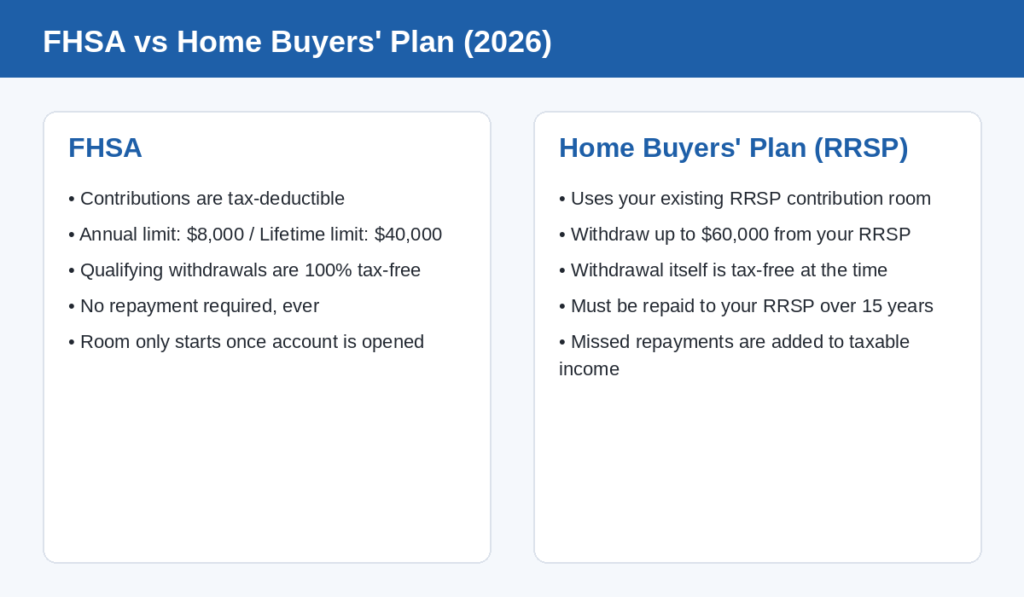
Comparison chart of FHSA versus Home Buyers Plan rules for 2026, Easy Tax Canada
Why Combine Both?
Because the FHSA and HBP draw from different accounts, eligible buyers can use both for the same home purchase. A single buyer could withdraw up to $40,000 tax-free from an FHSA and up to $60,000 from an RRSP under the HBP, for $100,000 in tax-advantaged down payment funds. A couple who each open an FHSA and each use the HBP could bring that combined total to $200,000, before regular savings are even factored in.
| Strategy we recommend to clients: prioritize maxing your FHSA first, since the withdrawal never has to be repaid. Use the HBP as a secondary source only if you need more than your FHSA and personal savings provide. |
Other Costs First-Time Buyers Should Plan For
Beyond the down payment, first-time buyers in Ontario should budget for Land Transfer Tax (with a rebate of up to $4,000 available for eligible first-time buyers), legal fees, a home inspection, and potentially the GST/HST New Housing Rebate if purchasing new construction. Each of these has its own eligibility rules, and missing a rebate application deadline is one of the most common ways buyers leave money on the table.
A Common Mistake We See
Many buyers open an FHSA the same year they plan to buy, not realizing that contribution room only begins accumulating once the account is opened, and that funds need time to settle before a qualifying withdrawal. If home ownership is even a possibility in the next few years, opening an FHSA now, even with a small initial deposit, starts the clock on your contribution room.
Final Thoughts
Between the FHSA, the Home Buyers’ Plan, and provincial rebates, there is more government support available to first-time buyers in 2026 than at almost any point in recent memory. The challenge is coordinating the pieces correctly, and that is where a short planning conversation before you start house hunting can make a real financial difference.
| Need Help With This? Talk to Easy Tax Canada. Our team is led by a former CRA Auditor and Collections Officer with over 15 years of experience, backed by CPAs who know the Canadian tax system inside and out. We help individuals, self-employed professionals, and small businesses across Mississauga, Brampton, and the Greater Toronto Area file accurately, plan ahead, and stay CRA-compliant year-round. Visit easytaxcanada.com to book a consultation or explore our blog for more tax guidance. |