
A Practical Guide for Remote and Hybrid Employees in Mississauga & Brampton
Home office expense tax deduction 2026 guide by Easy Tax Canada, accountants in Mississauga and Brampton
With hybrid and remote work now permanent for many GTA employees, we get one question constantly during tax season: “Can I still claim my home office?” The short answer is yes, if you meet the CRA’s conditions, but the rules are more detailed than most people realize. Here is what employees in Mississauga and Brampton need to know for the 2026 filing season.
Who Actually Qualifies
The temporary flat-rate method that many Canadians used during the pandemic is no longer available. To claim home office expenses today, employees must use the detailed method, which requires meeting one of two conditions: you worked from home more than 50% of the time for at least four consecutive weeks, or your employer required you to work from home and you paid for expenses related to that work.
Step One: Get Form T2200 Signed
Your employer must complete and sign Form T2200, Declaration of Conditions of Employment, confirming that you were required to maintain a home office and cover related costs. Without this form, the CRA will not accept your claim, no matter how legitimate your expenses are. Request this form early, ideally as soon as tax season opens, since employer payroll and HR departments can take time to process them.
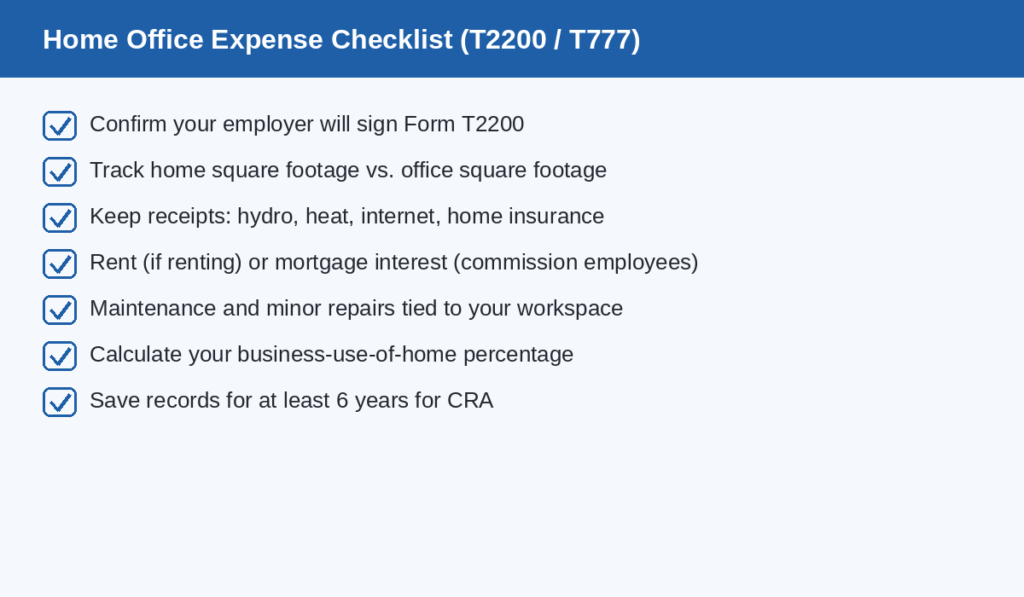
Home office expense checklist for CRA T2200 and T777 claims, Easy Tax Canada
What You Can Actually Claim
- A reasonable percentage of utilities: electricity, heat, and water, based on your workspace’s share of your home’s total square footage.
- Home internet access fees, prorated for work use.
- Rent, if you are a tenant (commission employees may also claim a portion of home insurance and property tax).
- Minor repairs and maintenance directly tied to your workspace.
- Office supplies such as pens, paper, and printer ink used for employment duties (not equipment like laptops or monitors, which fall under different rules).
Calculating Your Business-Use-of-Home Percentage
The CRA expects a reasonable, defensible calculation, typically the square footage of your dedicated workspace divided by the total finished square footage of your home. If your workspace is shared with personal use, for example a kitchen table used for both work and meals, you will also need to prorate for the hours per week the space is used for employment duties.
| Keep every receipt and your square footage calculation for at least six years. This is the documentation the CRA will request first if your claim is ever reviewed, and missing records are the single most common reason a home office claim gets denied. |
What Salaried vs. Commission Employees Can Claim
Salaried employees can claim utilities, internet, rent, and maintenance tied to their workspace. Commission employees have a slightly wider list of eligible expenses, including a portion of home insurance and property taxes, provided their income is commission-based and the T2200 confirms this. Self-employed individuals follow different, generally more generous, rules under business-use-of-home expenses, which we cover separately.
A Note for Mississauga and Brampton Employees
We regularly see two mistakes locally: employees who assume the pandemic-era flat rate still applies, and employees who claim expenses without a signed T2200 on file. Both lead to reassessments. Before you file, confirm your employer will issue the form, and take fifteen minutes to properly measure your workspace rather than estimating.
Final Thoughts
Home office deductions are legitimate and worthwhile for many remote and hybrid employees, but the CRA expects precise documentation, not estimates. Getting the T2200 signed early and keeping clean records throughout the year is the difference between a smooth claim and a stressful reassessment.
| Need Help With This? Talk to Easy Tax Canada. Our team is led by a former CRA Auditor and Collections Officer with over 15 years of experience, backed by CPAs who know the Canadian tax system inside and out. We help individuals, self-employed professionals, and small businesses across Mississauga, Brampton, and the Greater Toronto Area file accurately, plan ahead, and stay CRA-compliant year-round. Visit easytaxcanada.com to book a consultation or explore our blog for more tax guidance. |