
What Counts, What Doesn’t, and How Mississauga & Brampton Families Can Maximize It
Medical expense tax credit Canada 2026 guide by Easy Tax Canada, accountants in Mississauga and Brampton
Most Canadians pay some out-of-pocket medical costs every year, prescriptions, dental work, glasses, and more, without realizing how much of it can reduce their tax bill. Here is how the Medical Expense Tax Credit actually works in 2026, and where we see families leave money unclaimed.
How the Credit Works
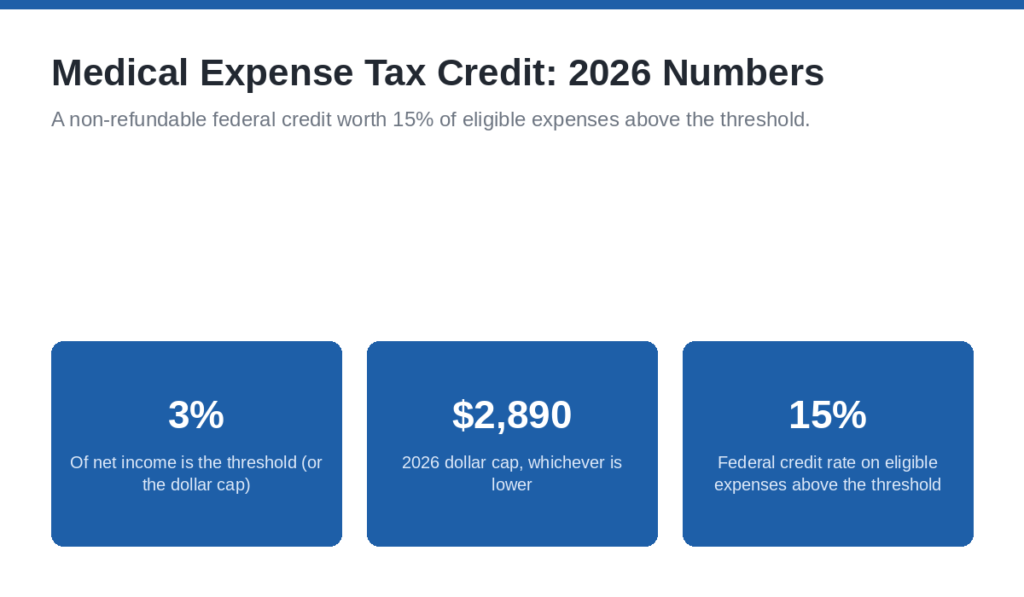
Medical expense tax credit numbers for 2026, threshold and rate, Easy Tax Canada
The Medical Expense Tax Credit (METC) is a non-refundable federal credit worth 15% of eligible medical expenses that exceed a threshold, calculated as the lesser of 3% of your net income or a fixed dollar cap, set at $2,890 for 2026. Most provinces, including Ontario, also offer an additional provincial credit on top of the federal amount.
In practical terms, if your net income is $70,000, your threshold is 3% of that, or $2,100, since it is lower than the $2,890 dollar cap. Every eligible dollar spent above that threshold generates a 15% federal credit, plus a provincial credit.
What You Can Claim
- Prescription medications, dental work, and vision care, including glasses and contact lenses.
- Premiums paid for private health and dental insurance plans, if not already covered by an employer on a pre-tax basis.
- Travel expenses for medical treatment not available locally, including a portion of mileage and, in some cases, accommodation.
- Certain home renovations and equipment required for a medical condition, such as wheelchair ramps or specialized medical devices.
- Attendant care and, for those eligible for the Disability Tax Credit, certain supplemental caregiving expenses.
Whose Expenses Can You Combine?
You can claim eligible medical expenses for yourself, your spouse or common-law partner, and your dependent children under 18 on one line of your return, and expenses for other dependants, such as a parent or adult child with a disability, on a separate line. Because the credit is based on a percentage of net income, it is almost always more beneficial for the lower-income spouse to claim the family’s combined medical expenses, since their income threshold will typically be lower.
| You can choose any 12-month period ending in the tax year to gather your medical expenses, it does not have to be the calendar year. This flexibility lets you combine expenses across a 12-month window that gives you the largest total claim. |
A Common Mistake We See
Many families default to claiming medical expenses on the higher-income spouse’s return simply because that is where most other deductions go. Because the METC threshold is tied to net income, this often results in a smaller credit than if the lower-income spouse claimed the same expenses. We review this every tax season for our Mississauga and Brampton clients, and it frequently changes the outcome.
Final Thoughts
The Medical Expense Tax Credit is one of the more flexible credits available, spanning a wide range of expenses and allowing strategic choices about timing and who claims it. Keeping receipts organized throughout the year, rather than trying to reconstruct them at tax time, makes it far easier to claim everything you are entitled to.
| Need Help With This? Talk to Easy Tax Canada. Our team is led by a former CRA Auditor and Collections Officer with over 15 years of experience, backed by CPAs who know the Canadian tax system inside and out. We help individuals, self-employed professionals, and small businesses across Mississauga, Brampton, and the Greater Toronto Area file accurately, plan ahead, and stay CRA-compliant year-round. Visit easytaxcanada.com to book a consultation or explore our blog for more tax guidance. |