
How Old Age Security Recovery Tax Works, and How to Plan Around It
OAS clawback and retirement income tax 2026 guide by Easy Tax Canada, accountants in Mississauga and Brampton
Many retirees assume the OAS clawback only affects the wealthy. In practice, a single large RRIF withdrawal, a capital gain from selling a rental property, or even continued part-time work can push a modest-income senior above the threshold. Here is how the OAS recovery tax works in 2026, and what our Mississauga and Brampton clients do to manage it.
CPP and OAS Are Both Fully Taxable
Unlike the TFSA or the tax-free portion of certain benefits, both CPP and OAS payments are fully taxable income and must be reported on your return each year. Neither is withheld automatically at source unless you specifically request voluntary tax deductions through Service Canada.
How the OAS Clawback Works
OAS clawback threshold comparison for 2026, Easy Tax Canada
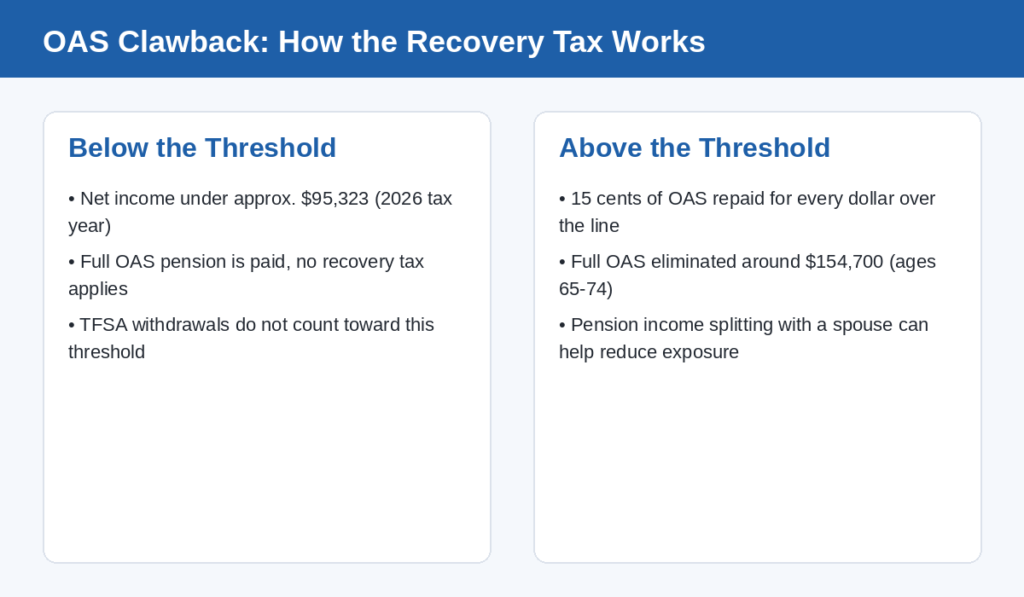
The OAS recovery tax, commonly called the clawback, reduces your OAS pension by 15 cents for every dollar of net income above a set threshold, approximately $95,323 for the 2026 tax year. Above roughly $154,700 in net income, OAS is fully eliminated for seniors aged 65 to 74, with a slightly higher ceiling for those 75 and older.
Importantly, the clawback is applied per individual, not per household, and it is based on your net income from line 23400, which includes RRIF withdrawals, employment income, rental income, and taxable capital gains. TFSA withdrawals are not counted, which is why many retirees prioritize drawing down TFSA savings before other income sources once they are close to the threshold.
| Service Canada withholds recovery tax based on your income from two years earlier, then reconciles the actual amount owed when you file your return. A high-income year can therefore reduce your OAS cheque well into the following year, even after your income has dropped back down. |
Strategies We Use With Retired Clients
- Pension income splitting: eligible pension income, including RRIF withdrawals, can be split up to 50/50 with a spouse using Form T1032, which can bring a higher-income spouse below the clawback threshold.
- Sequencing withdrawals: drawing down TFSA savings before RRSP or RRIF income in years close to the threshold.
- Timing large income events: realizing a large capital gain or RRSP withdrawal in a year when other income is already elevated, rather than spreading unnecessary spikes across otherwise low-income years.
- For incorporated business owners, retaining earnings inside the corporation rather than drawing them out personally, since corporate retained earnings do not count toward the clawback threshold.
Final Thoughts
The OAS clawback functions like an extra 15% tax bracket layered on top of your regular rate, and it catches more retirees every year as CPP amounts and pension income rise with inflation. A short annual review of your expected income sources can often keep you below the threshold, or at least limit how much OAS you give back.
| Need Help With This? Talk to Easy Tax Canada. Our team is led by a former CRA Auditor and Collections Officer with over 15 years of experience, backed by CPAs who know the Canadian tax system inside and out. We help individuals, self-employed professionals, and small businesses across Mississauga, Brampton, and the Greater Toronto Area file accurately, plan ahead, and stay CRA-compliant year-round. Visit easytaxcanada.com to book a consultation or explore our blog for more tax guidance. |