
If you’re an incorporated truck driver in Ontario — or a carrier that hires them — the term “Personal Services Business” (PSB) should be on your radar right now. The CRA has sharpened its focus on what the trucking industry calls the “Driver Inc.” model, and starting with the 2025 tax year, the penalties for getting it wrong are no longer on pause. If your corporation gets reclassified as a PSB, the tax hit can be severe — and it can apply retroactively to past years.
At EasyTaxCanada, we work with owner-operators and incorporated drivers across Mississauga, Brampton, and the greater GTA and Peel Region every day, so we’ve put together this plain-language guide to what a PSB is, why truck drivers are squarely in the CRA’s sights, and what you can do to protect yourself.
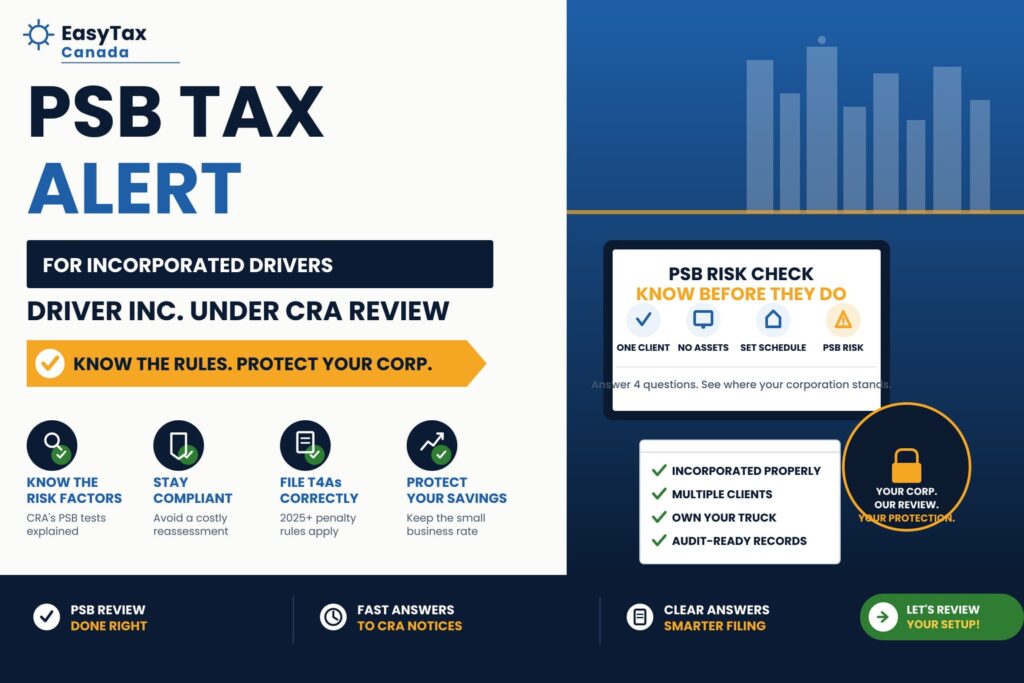
What Is a Personal Services Business?
A Personal Services Business is the CRA’s label for a corporation that, in substance, is just an employee working through a corporate shell. The legal test is simple to state and harder to apply: if you would reasonably be considered an employee of the company paying you were it not for your corporation, the CRA can treat your corporation as a PSB.
In the trucking world, this is often called the “Driver Inc.” model — a commercial driver incorporates, sets up a numbered company, and that company’s only client is the trucking company or carrier the driver hauls for. On paper it looks like a business relationship between two corporations. In practice, the CRA looks past the paperwork at how the work actually happens.
Why Truck Drivers Are the CRA’s Top PSB Target
Trucking is one of the industries the CRA has specifically flagged in its PSB compliance work, and it isn’t subtle about it. A few factors push incorporated drivers toward PSB status more than almost any other profession:
- Working exclusively, or almost exclusively, for one carrier
- Not owning, leasing, or registering the truck or equipment being used
- Being told when, where, and how to drive, with little independent control over the work
- Being incorporated because the carrier required it as a condition of getting hired, rather than for genuine business reasons
- Having no other clients, no marketing presence, and no real chance of a business loss
Many drivers incorporate for entirely legitimate reasons and run genuine owner-operator businesses. Incorporation itself is not the problem — the CRA cannot and does not stop anyone from incorporating. The problem is when the day-to-day reality of the work still looks exactly like employment.
The 2025–2026 Crackdown: What’s Different Now
This isn’t a theoretical risk anymore. The CRA has lifted its moratorium on penalties for failing to report fees-for-service payments in the trucking industry, effective with the 2025 tax year. That means trucking companies can now be penalized for failing to issue T4A slips for payments over $500 made in a calendar year to incorporated drivers.
On top of that, the federal government’s Budget 2025 earmarked dedicated funding for a focused CRA compliance program targeting PSB non-compliance and fees-for-service reporting specifically in the trucking sector. In short: both carriers and incorporated drivers are being watched more closely than ever, and the paperwork gaps that used to slide are now penalty-eligible.
How Much More Tax Does a PSB Actually Pay?
This is where the risk becomes very concrete. A corporation classified as a PSB loses two of the biggest tax advantages of incorporating: the small business deduction and the general rate reduction. The result is a combined federal and provincial tax rate of roughly 33% on every dollar of income — with almost no deductions to offset it.
| Regular CCPC (Small Business) | Personal Services Business (PSB) |
| Eligible for the small business deduction (lower tax rate on active business income) | Small business deduction denied — no reduced rate |
| Eligible for the general rate reduction | General rate reduction denied — taxed at the full federal/provincial rate, roughly 33% combined |
| Broad range of deductible business expenses (fuel, insurance, meals, cell phone, office costs, etc.) | Expenses limited mainly to salary/wages paid to the incorporated employee, certain benefits, and costs of selling property or negotiating contracts |
| Can retain earnings in the corporation for tax deferral | Little to no tax deferral advantage — most income effectively flows through as if it were salary |
On top of the higher rate, a PSB can generally only deduct salary and wages paid to the incorporated employee, certain employment-related benefits, and the costs of selling property or negotiating contracts. Fuel, insurance premiums, meals, cell phone bills, and other everyday trucking expenses that a legitimate owner-operator business would normally write off are largely off the table for a PSB.
Worse, this isn’t only a going-forward problem. If the CRA reassesses prior years, a driver can be hit with back taxes, interest, and penalties across multiple tax years at once — a bill that can easily run into the tens of thousands of dollars.
Signs Your Corporation Could Be Flagged as a PSB
- You have one client — the carrier or trucking company you drive for — and always have
- You don’t own or lease the truck, trailer, or major equipment you use
- The carrier sets your schedule, routes, and rules the way an employer would
- You were told to incorporate before you could start hauling for the company
- Your corporation has no other assets, contracts, or business activity beyond your own driving
- You don’t carry the kind of financial risk a genuine business owner would (no chance of loss on a job)
None of these factors alone is automatically fatal, and the CRA looks at the whole picture rather than a single checkbox. But the more of these that apply, the higher the risk.
How Incorporated Drivers Can Protect Themselves
- Diversify your client base where possible, rather than relying on a single carrier
- Own or lease your own truck and equipment, and keep that ownership properly documented
- Keep clear records showing you control how, when, and where the work gets done
- Make sure your corporation carries genuine business risk and operates like an independent business, not an extension of the carrier
- Get your incorporation and contracts reviewed against the CRA’s PSB factors before problems arise, not after a reassessment letter shows up
- If you receive a PSB notice or reassessment, respond promptly and get professional help before the deadline to dispute passes
What Carriers Need to Know Too
It isn’t only drivers at risk. Trucking companies that pay incorporated drivers now face penalties for failing to properly report those fee-for-service payments on T4A slips. If you run or manage a trucking business in Ontario and work with incorporated drivers, this is a good time to review how those relationships are structured and documented, before the CRA’s focused compliance program reaches your file.
Get PSB Peace of Mind From Someone Who’s Seen It From Inside the CRA
PSB rules are exactly the kind of grey-area, judgment-call file where the CRA’s own internal thinking matters most — and that’s where Amir Khawaja’s background gives EasyTaxCanada clients a real edge. As a former CRA Auditor and Collections Officer with over 15 years of experience, Amir has seen these files from the other side of the desk. He and our team of CPAs help incorporated truck drivers and owner-operators across Mississauga, Brampton, the GTA, and Peel Region review their structure, correct filing gaps, and respond to PSB and T4A compliance notices before they turn into a five-figure tax bill.
Whether you’re incorporating for the first time, worried about how your current setup looks to the CRA, or you’ve already received a notice, get in touch with EasyTaxCanada for a review tailored to the trucking industry.
EasyTaxCanada
Mississauga Office: Unit 125-1454 Dundas St E, Mississauga, ON
Brampton Office: 22 Donlamont Circle, Brampton, ON