
A Mississauga & Brampton Accountant’s Guide to Choosing the Right Registered Account
RRSP vs TFSA 2026 comparison guide by Easy Tax Canada, accountants in Mississauga and Brampton
Every year, thousands of Mississauga and Brampton residents ask us the same question: should I put my money into an RRSP or a TFSA? Both accounts shelter your money from tax, but they work in very different ways, and the right choice depends on your income, your goals, and your timeline. Here is how the two accounts compare for the 2026 tax year, and how to decide which one deserves your next dollar.
The 2026 Numbers You Need to Know
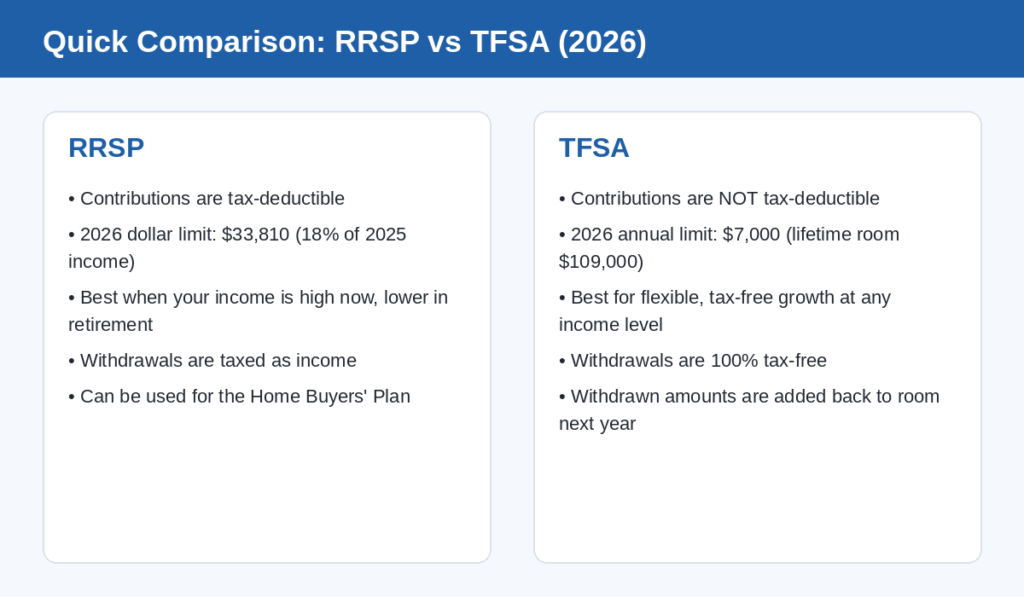
- RRSP dollar limit for 2026: $33,810 (or 18% of your 2025 earned income, whichever is lower, plus any unused room carried forward).
- TFSA annual limit for 2026: $7,000. If you have never contributed and have been eligible since 2009, your cumulative TFSA room is now $109,000.
- RRSP contribution deadline for the 2025 tax year: March 2, 2026. Contributions made after that date apply to your 2026 return.
- Both RRSP and TFSA over-contributions can trigger a 1% per month penalty tax on the excess amount, so always confirm your exact room through CRA My Account before contributing.
How Each Account Actually Works
An RRSP (Registered Retirement Savings Plan) gives you a tax deduction the year you contribute, which lowers your taxable income right now. Your investments grow tax-deferred inside the account, but every dollar you withdraw in retirement is taxed as regular income. This makes the RRSP most powerful when your income, and your marginal tax rate, is higher today than it will be when you retire.
A TFSA (Tax-Free Savings Account) works in reverse. You contribute with after-tax dollars, so there is no deduction up front, but every dollar of growth and every withdrawal is completely tax-free, for life. There is also no requirement to ever withdraw the funds, and any amount you take out is added back to your contribution room the following calendar year, which makes the TFSA the more flexible of the two accounts.
Side-by-side comparison chart of RRSP and TFSA rules for 2026, Easy Tax Canada
Which One Should You Choose?
As a general rule, the RRSP tends to make more sense if you are in a higher tax bracket today and expect your income to drop in retirement, for example a mid-career professional in Mississauga earning $90,000 or more. The deduction you receive now is worth more than the tax you will eventually pay on withdrawal.
The TFSA tends to win for younger workers, newcomers to Canada still building income, and anyone who wants easy access to their savings without a tax bill attached, whether that is for a home down payment, an emergency fund, or early retirement income. Many of our Brampton clients use their TFSA as a flexible top-up account precisely because withdrawals do not affect other income-tested benefits such as the GST/HST credit or Old Age Security.
| Rule of thumb we use with clients: if your marginal tax rate is meaningfully lower in retirement than it is today, favour the RRSP. If your income is modest or your tax bracket is unlikely to change much, favour the TFSA, or split contributions between both. |
A Common Mistake We See in the GTA
One of the most frequent errors we correct during tax season is clients contributing to whichever account their bank suggested, without checking actual contribution room first. Because TFSA information at the CRA is sometimes not fully updated until later in the year, and RRSP room depends on last year’s income, it is easy to accidentally over-contribute. We recommend confirming your exact limits through CRA My Account, or your Notice of Assessment, before making a lump-sum contribution.
Can You Use Both?
Yes, and for most households the ideal strategy blends the two. A common approach for self-employed professionals and small business owners we work with in Mississauga and Brampton is to use the RRSP to reduce taxable business or employment income during high-earning years, while steadily building TFSA room for shorter-term goals and tax-free flexibility later on.
Final Thoughts
There is no single right answer for every taxpayer. Your income level, career stage, and financial goals all shape which account should get priority in 2026. If you are unsure where your next contribution dollar should go, a short conversation with a tax professional can save you far more than the cost of the appointment.
| Need Help With This? Talk to Easy Tax Canada. Our team is led by a former CRA Auditor and Collections Officer with over 15 years of experience, backed by CPAs who know the Canadian tax system inside and out. We help individuals, self-employed professionals, and small businesses across Mississauga, Brampton, and the Greater Toronto Area file accurately, plan ahead, and stay CRA-compliant year-round. Visit easytaxcanada.com to book a consultation or explore our blog for more tax guidance. |