
What Students and Parents in Mississauga & Brampton Should Know
Tuition and student tax credits Canada 2026 guide by Easy Tax Canada, accountants in Mississauga and Brampton
Post-secondary education is expensive, and many students, and the parents helping fund it, don’t realize how the tuition tax credit actually works. Here is a plain-language breakdown for the 2026 filing season, including a change to the federal credit rate that took effect this year.
The Federal Tuition Tax Credit
Eligible tuition fees over $100, paid to a CRA-approved post-secondary institution, generate a non-refundable federal tax credit. Starting in 2026, this credit is calculated using the lowest federal tax bracket rate, which dropped to 14%, down slightly from prior years. Your institution will issue a T2202 (or TL11A, TL11C, or TL11D for study outside Canada) showing your eligible fees for the year.
Important: Ontario No Longer Has a Provincial Tuition Credit
Ontario eliminated its provincial tuition and education tax credit for expenses incurred after September 2017. This means Mississauga and Brampton students today only receive the federal credit on their tuition, not a matching provincial credit, which is a common point of confusion for families used to older tax rules.
If You Don’t Owe Enough Tax to Use the Full Credit
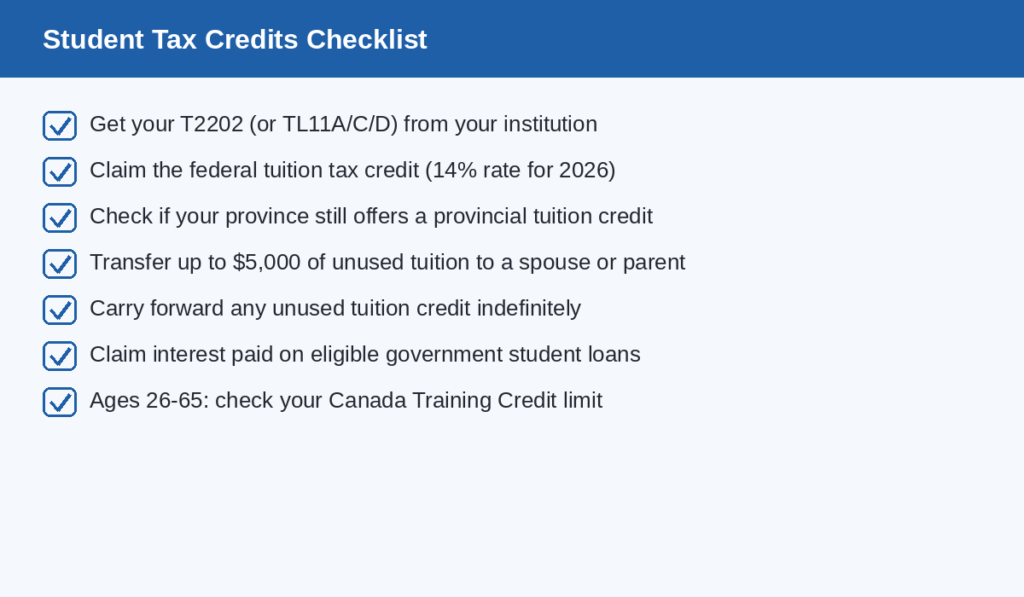
Student tax credits checklist for the 2026 filing season, Easy Tax Canada
- Carry forward: unused tuition credit amounts can be carried forward indefinitely to future years when you owe more tax.
- Transfer to family: you can transfer up to $5,000 of unused current-year tuition to a spouse, parent, or grandparent, but only the portion you don’t personally need to reduce your own tax to zero.
- You cannot do both for the same amount: any tuition transferred to a family member reduces what you can carry forward for yourself.
| Many students transfer the maximum $5,000 to a parent by default, without checking whether they will actually owe tax in future years. If you expect to start working and owing tax soon after graduation, carrying the credit forward yourself may be worth more than transferring it. |
The Canada Training Credit
Separate from the tuition credit, working-age adults between 26 and 65 can accumulate a Canada Training Credit (CTC) limit of $250 per year, up to a lifetime maximum of $5,000, provided they meet minimum working income requirements and stay under an upper net income threshold. When you take an eligible training course, you can claim the lesser of half your eligible fees or your accumulated CTC limit as a refundable credit, meaning it can generate a refund even if you owe no tax.
Other Credits and Deductions for Students
- Interest paid on eligible federal or provincial student loans can be claimed as a non-refundable credit, and unused amounts can be carried forward up to five years.
- Moving expenses can be deducted if you moved at least 40 kilometres closer to a post-secondary institution for full-time study, though this deduction can only be used against scholarship or employment income earned at the new location.
Final Thoughts
Tuition credits are valuable, but the rules around transferring versus carrying forward, and the loss of Ontario’s provincial credit, catch many GTA families off guard. A quick review each year, especially in a student’s first and final years of school, can make a meaningful difference in the family’s combined tax bill.
| Need Help With This? Talk to Easy Tax Canada. Our team is led by a former CRA Auditor and Collections Officer with over 15 years of experience, backed by CPAs who know the Canadian tax system inside and out. We help individuals, self-employed professionals, and small businesses across Mississauga, Brampton, and the Greater Toronto Area file accurately, plan ahead, and stay CRA-compliant year-round. Visit easytaxcanada.com to book a consultation or explore our blog for more tax guidance. |